

Phone screen interviews are often short, early, and surprisingly influential. They’re not designed to trip you up—but they are designed to filter quickly.
That’s why knowing the types of phone interview questions you’re likely to hear matters more than memorizing perfect answers. Interviewers are listening for clarity, alignment, and how easily they can understand your value in a short conversation.
Below are some of the most common phone interview questions, why they’re asked, and how to answer them without overthinking.
If you want help with pacing, tone, and delivery during a phone screen, this article pairs well with your guide on phone interview tips.
1. Can You Walk Me Through Your Background?
Why this question is asked
This is usually the opening question after introductions. It helps the interviewer understand how your experience maps to the role. You may also hear this question phrased as “Walk me through your resume.”
How to approach your answer
Your response will set the context for the rest of the conversation. Focus on what’s most relevant, not your full history. Highlight progression and impact, and keep it concise and role-aligned. You don’t need to start at the beginning of your career—start where it becomes relevant.
Sample answer
“I’ve spent the last five years working in marketing roles focused on growth and analytics. Most recently, I led content strategy for a mid-sized tech company, where I partnered closely with product and content teams. That experience is what drew me to this role, since it combines strategy with cross-functional work.”
2. What Interested You in This Role?
Why this question is asked
This helps interviewers understand your motivation, whether you’re applying thoughtfully, and how well you understand the role.
How to approach your answer
Connect the role to your experience and interests. Avoid generic enthusiasm or flattery. Show alignment, not desperation.
Sample answer
“What stood out to me is the emphasis on ownership and collaboration. In my current role, I’ve enjoyed working closely with cross-functional partners, and this position seems to offer more scope and impact in that area.”
3. Why Are You Looking to Make a Change Right Now?
Why this question is asked
Interviewers want clarity around timing and context, and to surface any potential misalignment early.
How to approach your answer
Stay forward-looking and professional. Avoid oversharing or venting. Frame the change as growth or alignment.
Sample answer
“I’ve grown a lot in my current role, but I’ve reached a point where I’m looking for broader responsibility and new challenges. I’m being intentional about finding a role that better matches where I want to grow next.”
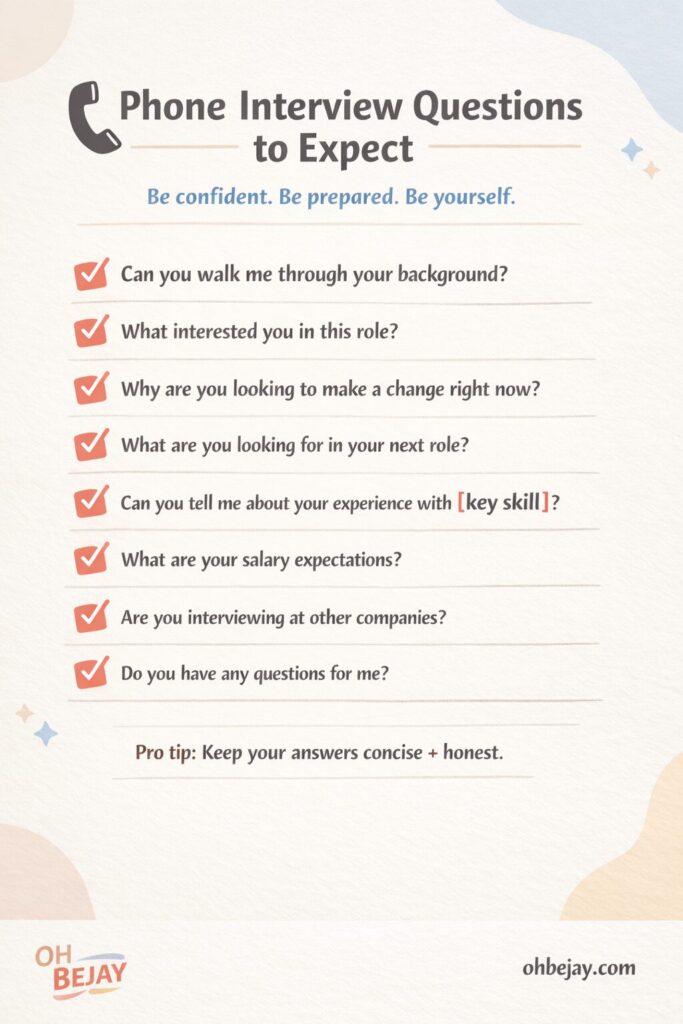
4. What Are You Looking for in Your Next Role?
Why this question is asked
This helps interviewers check expectations around scope, impact, and environment to avoid misalignment later.
How to approach your answer
Be clear without being rigid. Focus on priorities rather than a long wish list.
Sample answer
“I’m looking for a role where I can have meaningful ownership, collaborate closely with a team, and continue building strategic skills. I’m especially interested in environments where clarity and thoughtful execution are valued.”
5. Can You Tell Me About Your Experience With [Key Skill]?
Why this question is asked
Recruiters use this question to ensure you have the required skills for the role. They’re also assessing your fluency with certain tools at high level.
How to approach your answer
Be clear about your expertise. Lead with outcomes, then add context. Keep it high-level—this is not a deep technical interview.
Sample answer
“In my last role, project management was a core part of my responsibilities. I led weekly meetings and worked closely with content and engineering teams. By maintaining project schedules, I contributed to sustained organic growth and supported several successful product launches.”
6. What Are Your Salary Expectations?
Why this question is asked
This ensures early alignment on compensation.
How to approach your answer
Stay calm and matter-of-fact. Share a range when appropriate and anchor it to role scope and market.
Sample answer
“Based on the role’s scope and my experience, I’m targeting a range between X and Y. I’m open to discussing the full compensation package as we learn more about mutual fit.”
7. Are You Interviewing at Other Companies?
Why this question is asked
Interviewers use this to get a gauge of urgency and how to manage timelines. If you’re a strong candidate and you’re interviewing elsewhere, the recruiter may speed up the process to make sure they can give you an offer in time.
How to approach your answer
Be honest without oversharing. You can say you’re interviewing without sharing details about which companies or exactly how far along you are in the process. Avoid sounding evasive or overly strategic.
Sample answer
“Yes, I’m speaking with a few companies right now, but I’m being selective. I’m focused on finding the right fit.”
8. Do You Have Any Questions for Me?
Why this question is asked
This question gives you a chance to get further clarity on the role and the company, and it assesses how seriously you’re considering the role.
How to approach your answer
Ask questions that show discernment. Focus on team dynamics, priorities, and success. Avoid questions that are easily answered online.
Sample questions you can ask
-
“What would success look like in the first six months? And how does that evolve for the rest of the year?”
-
“Can you tell me about a recent project that demonstrates how this role collaborates with other teams?”
-
“What are the top three challenges the team is focused on right now?”
-
“What are the ways do you measure impact for this role?”
How Phone Screen Questions Are Evaluated
During phone screens, interviewers are listening for clear communication, role alignment, and thoughtful engagement. The initial phone interview rarely goes into depth about the technical aspects of the role. That usually comes later. For this first interview, focus on how your experience aligns with the role and the company as a whole.
Final Thoughts
Phone interview questions are more predictable than questions in other interview rounds. Preparing for how to answer—clearly and calmly—matters much more than memorizing exact wording.
The goal of a phone screen is to make your value easy to understand and determine whether it makes sense to move forward. For more tips, check out our full guide on phone interviews.