

Table of Contents
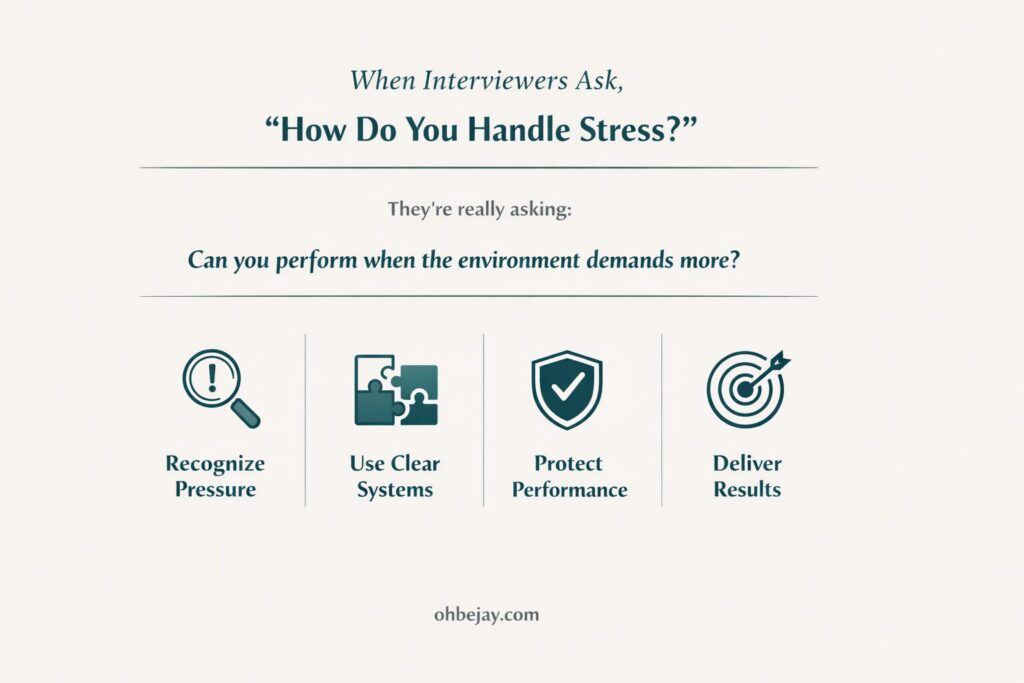
When an interviewer asks, “How do you handle stress?” they’re not asking for your entire self-care routine.
They’re trying to understand something more practical: Can you perform well in this role when pressure increases?
Some jobs come with tight deadlines. Others involve difficult clients, high stakes, or responsibility for people and outcomes. This question helps interviewers assess whether you can handle the environment you’re walking into.
Handled well, it’s not a trick question. It’s an opportunity to show maturity and that you’re capable of handling the role.
Interviewers want to know:
- Do you recognize when you’re under stress?
- Do you respond productively or react impulsively?
- Can you stay clear and composed when stakes are high?
- Are you a realistic fit for the level of stress in this role?
Everyone experiences stress from time-to-time. That’s normal. Interviewers are evaluating whether stress disrupts your performance — or sharpens it.
5 Strong Sample Answers
Strong answers to this question include these crucial elements:
- Self-awareness
You understand what pressure feels like for you. - Specific strategies
You don’t just say, “I stay calm.” You explain how. - Professional framing
You keep the focus on work — not personal overwhelm. - Evidence of results
You show that you can still deliver under pressure.
Below are five sample answers based on your role and experience. Notice how each one keeps the focus on work performance.
1. General Professional Context
“I handle stress by focusing on what I can control. When pressure increases, I break the situation into smaller priorities and address them methodically. I’ve found that staying organized and communicating clearly with stakeholders prevents stress from escalating. In high-pressure moments, I aim to stay steady so the team can rely on me.”Why this works:
It demonstrates organization and reliability without sounding dramatic.
2. Deadline-Driven Role
“In deadline-driven environments, I’ve learned that preparation reduces stress significantly. I map out timelines early, identify potential bottlenecks, and build in buffer space when possible. When unexpected pressure comes up, I reassess priorities quickly and communicate clearly about what needs to shift. That approach has helped me consistently deliver even when timelines are tight.”Why this works:
It shows proactive planning and adaptability — not panic. This response is great for roles in Marketing and Operations — or roles with a lot of deliverables.
3. Fast-Paced Environment
“In fast-moving environments, stress often comes from shifting priorities. I handle that by staying flexible and focusing on outcomes rather than rigid plans. When priorities change, I confirm expectations quickly and adjust my workload accordingly. I’ve found that staying solution-oriented keeps momentum strong even during high-growth phases.”Why this works:
It demonstrates comfort with ambiguity and change. This response is especially fitting for roles in tech startups.
4. Team Lead
“As a team lead, I understand that my response to stress sets the tone for others. When situations become high-pressure, I focus on staying composed and communicating clearly. I prioritize transparency, delegate appropriately, and ensure the team understands next steps. My goal is to create stability, even when the environment feels demanding.”Why this works:
It shows leadership maturity and emotional regulation. This response is great for roles with a lot of direct reports.
5. High Workload
“When stress comes from workload volume, I rely on prioritization and realistic pacing. I assess urgency versus importance, address high-impact tasks first, and avoid multitasking unnecessarily. If capacity becomes a concern, I communicate early rather than letting pressure build silently. That approach has allowed me to maintain quality even during peak periods.”Why this works:
It demonstrates time management and responsible communication — two valuable skills. This response is fitting for roles with high-volume workloads.
Common Industries Where This Question Comes Up
You’re more likely to hear this question in roles where stress is inherent to the work, such as:
- Healthcare (nurses, physicians, emergency responders)
- Finance and banking
- Sales and business development
- Customer-facing support roles
- Operations and project management
- Startups and high-growth tech companies
- Legal professions
- Education
For example, surveys from the American Psychological Association consistently show that workplace stress remains a significant issue across industries, particularly in roles with high responsibility and time pressure.
Interviewers aren’t hiding away from the realities of stress — they know it’s part of the job. Being asked this question often reflects realism, not skepticism.
How to Talk About Stress Without Oversharing
This is where some candidates unintentionally hurt themselves.
Avoid:
- Sharing deeply personal emotional details
- Talking extensively about burnout unless fully resolved
- Describing yourself as easily overwhelmed
- Using clinical language in a professional setting
Instead:
- Focus on work scenarios
- Keep your tone steady and not overly emotional
- Show that stress doesn’t derail your output
You don’t need to pretend you never feel pressure. The goal is to demonstrate that you handle it constructively.
Is Being Asked This Question a Red Flag?
Not necessarily. In many cases, it simply reflects that the role genuinely includes pressure — and the company wants to be upfront about that.
It’s not automatically negative. It’s information. If you consistently hear this question in interviews for a specific role, take that as insight into the stress level that comes with that job.
How Specific Should I Be?
You can be specific, but keep your examples professional and contained.
It’s okay to mention tight deadlines, high expectations, or fast-paced environments. Just avoid framing them as overwhelming or traumatic. The focus should be on how you navigated them successfully.
Can I Talk About Personal Stress Outside Work?
In most professional interviews, it’s better to keep the conversation work-focused.
You can reference habits like meditation, exercise, and deep breathing. But avoid turning the answer into a discussion about personal coping mechanisms unrelated to job performance.
Final Thoughts
Some roles genuinely come with higher pressure. It’s better for both sides to acknowledge that upfront. The key is making sure that your answer reflects your real capacity and not inflated confidence.
Interview questions don’t have to catch you off guard. I cover these strategies in depth inside my hard questions interview training course. There I break down how to handle the toughest questions step-by-step.