

Table of Contents
- 1. “How old are you?”
- 2. “What year did you graduate?”
- 3. “Are you married?” and “Do you have children?”
- 4. “Do you plan to have children?”
- 5. “What religion do you practice?” or “Do you observe certain holidays?”
- 6. “Do you have any disabilities or health conditions?”
- 7. “Have you ever filed a workers’ compensation claim?”
- 8. “Where are you from?” or “Are you a U.S. citizen?”
- 9. “Have you ever been arrested?”
- 10. “What clubs, organizations, or groups do you belong to?”
- When a Question Is Personal but Not Illegal
- Why Do Employers Ask About Gender, Disability, and Veteran Status on Applications?
- What to Do If You Accidentally Share Protected Information
- Final Thoughts
Laws prevent certain interview questions for a good reason: to prevent discrimination.
Federal employment laws protect candidates from being evaluated based on age, race, religion, disability, national origin, and other personal characteristics that have nothing to do with job performance.
Most interviewers aren’t trying to violate the law. Sometimes they’re making small talk. Sometimes they simply don’t realize a question crosses a line.
Below are common illegal (or highly problematic) interview questions. We explain why they’re illegal and how you can respond professionally if you’re asked any of these questions.
1. “How old are you?”
Age discrimination is prohibited under the Age Discrimination in Employment Act (ADEA), which protects individuals age 40 and older.
An interviewer cannot ask your age directly. They also shouldn’t ask questions designed to infer it.
If asked, you could say:
“I’m confident I meet the experience requirements for this role and would be happy to speak more about my background.” This redirects to qualifications without escalating.
2. “What year did you graduate?”
This is often used to estimate age, which again falls under the ADEA.
Even if framed casually, it’s not relevant to your ability to do the job.
You can respond by focusing on experience:
“I’ve spent the last several years building experience in [area], particularly in…”Shift the conversation back to capability.
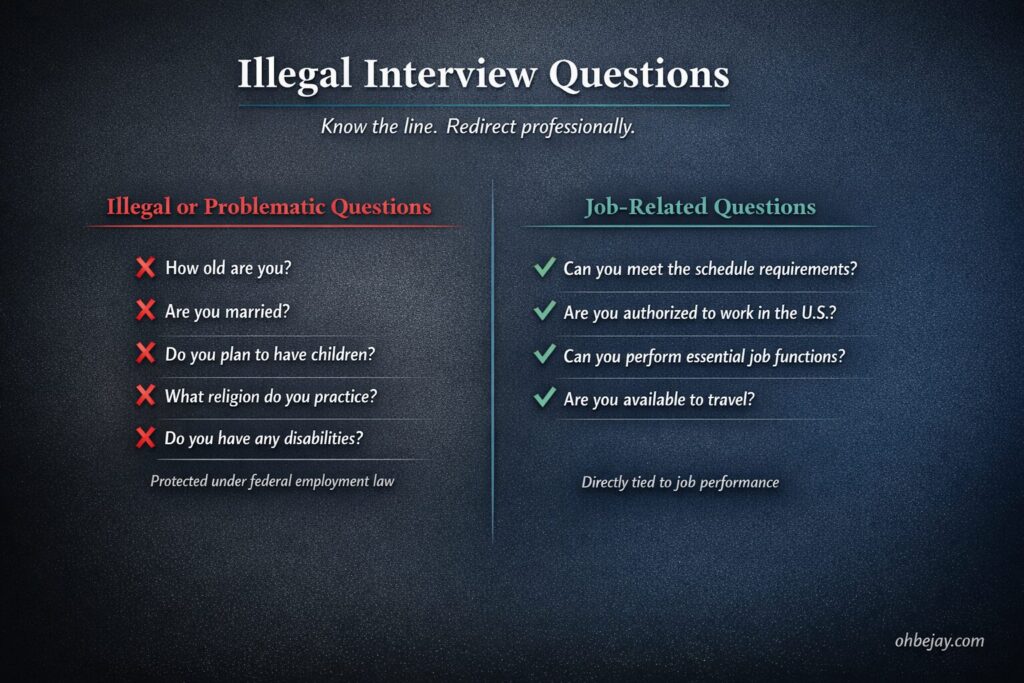
3. “Are you married?” and “Do you have children?”
Questions about marital or family status can violate Title VII of the Civil Rights Act of 1964, which prohibits discrimination based on sex and other protected characteristics.
Even if asked casually, your personal family situation is not a job requirement.
A simple redirect works:
“I’m fully able to meet the travel and schedule requirements of this role.”That answers the underlying concern without sharing personal details.
4. “Do you plan to have children?”
This question also falls under Title VII and pregnancy discrimination protections.
Your family planning is not relevant to job performance, and it’s illegal for that to influence hiring decisions.
You might say:
“I’m very focused on my professional growth and excited about opportunities like this.”Short. Calm. Forward-looking.
5. “What religion do you practice?” or “Do you observe certain holidays?”
Religion is protected under Title VII. An employer can discuss scheduling requirements. They cannot ask about your religious beliefs.
If it comes up, you could respond:
“I’m able to meet the scheduling expectations of the role.”If accommodations are needed, that’s a separate discussion — and one you can initiate on your terms.
6. “Do you have any disabilities or health conditions?”
The Americans with Disabilities Act (ADA) prohibits employers from asking about disabilities before making a job offer.
They can ask whether you can perform essential job functions with or without reasonable accommodation. They cannot ask about diagnoses.
If asked directly, you might say:
“I’m able to perform the essential functions of the role.”Redirect to focusing on your ability to do the job.
7. “Have you ever filed a workers’ compensation claim?”
This can violate protections under the ADA and related anti-retaliation provisions. It’s not a legitimate factor to consider when hiring an employee.
If asked:
“I’m confident I can perform the duties required for this position.”Keep your response focused on performance.
8. “Where are you from?” or “Are you a U.S. citizen?”
Questions about national origin are prohibited under Title VII.
Employers are allowed to ask whether you are legally authorized to work in the United States. That is different.
If asked about origin:
“I’m authorized to work in the U.S. and can provide documentation if needed.”That answers the lawful concern.
9. “Have you ever been arrested?”
According to guidance from the Equal Employment Opportunity Commission (EEOC), arrest records alone are not proof of criminal conduct and can disproportionately impact certain groups.
Employers may ask about convictions depending on the role. Arrest history alone is problematic.
If needed, you can ask for clarification:
“Are you asking about convictions related to the responsibilities of this role?”10. “What clubs, organizations, or groups do you belong to?”
This can indirectly reveal protected characteristics such as religion, race, or national origin.
Employers can ask about professional affiliations. They should not probe into personal associations.
You can respond by highlighting professional memberships only:
“I’m active in several industry-related organizations, including…”Keep it work-related.
When a Question Is Personal but Not Illegal
A question can be uncomfortable without being illegal.
For example:
- “Are you available to work weekends?”
- “Can you travel 30% of the time?”
- “Do you have reliable transportation?”
- “Are you authorized to work in the U.S.?”
These are tied to job requirements.
The difference is whether the question relates directly to your ability to perform the role. Understanding that distinction helps you stay measured instead of reactive.
Why Do Employers Ask About Gender, Disability, and Veteran Status on Applications?
You’ve probably seen voluntary demographic questions on job applications:
- Gender
- Race/ethnicity
- Disability status
- Veteran status
You might wonder: If those questions are illegal in interviews, why are they allowed on applications?
Here’s the difference:
Employers are required to collect demographic data for compliance and reporting under federal laws enforced by the EEOC and the Office of Federal Contract Compliance Programs (OFCCP).
Those answers are:
- Voluntary
- Separated from hiring decision-makers
- Used for aggregate reporting, not individual selection
You can decline to answer them without harming your application.
That process is very different from an interviewer directly asking you about a protected characteristic.
What to Do If You Accidentally Share Protected Information
This happens more often than people realize. I’m guilty of it myself.
You might casually mention your kids. Or your church. Or a medical situation. Or your age in a story.
If you do, it’s not the end of the world. If you feel you’ve drifted into personal territory, you can redirect with a phrase like:
“Ultimately, what’s most relevant here is…”
Then move back to skills, outcomes, and impact.
If something felt inappropriate and continues to concern you, document it afterward for your records.
Final Thoughts
You don’t need to disclose information that isn’t relevant to your ability to do the job.
Know your rights. Redirect when necessary. And remember: your qualifications are what belong at the center of the conversation. If you’d like more guidance for an upcoming interview, explore our many resources for interview prep.