
Table of Contents
- What Hiring Managers Actually Look for in Project Managers
- Project Manager Interview Questions That Reveal Strong Candidates
- Tell me about a project that went off track. What did you do next?
- Tell me about a project that was in trouble. What were the first steps you took?
- How do you manage conflict within a project team?
- How do you handle stakeholder disagreements?
- How do you identify and manage project risks?
- How do you explain technical delays to non-technical stakeholders?
- Common Mistakes Candidates Make in Project Manager Interviews
- How AI Is Changing Expectations for Project Managers
- Traits That Separate Exceptional Project Managers From Average Ones
If you search for “project manager interview questions,” you’ll find dozens of lists. Most focus on the basics of project management: how to talk about Agile, how to describe timelines, how to explain project frameworks.
However, hiring managers aren’t only evaluating your certifications and knowledge of tools. They’re evaluating how you think and how you solve problems.
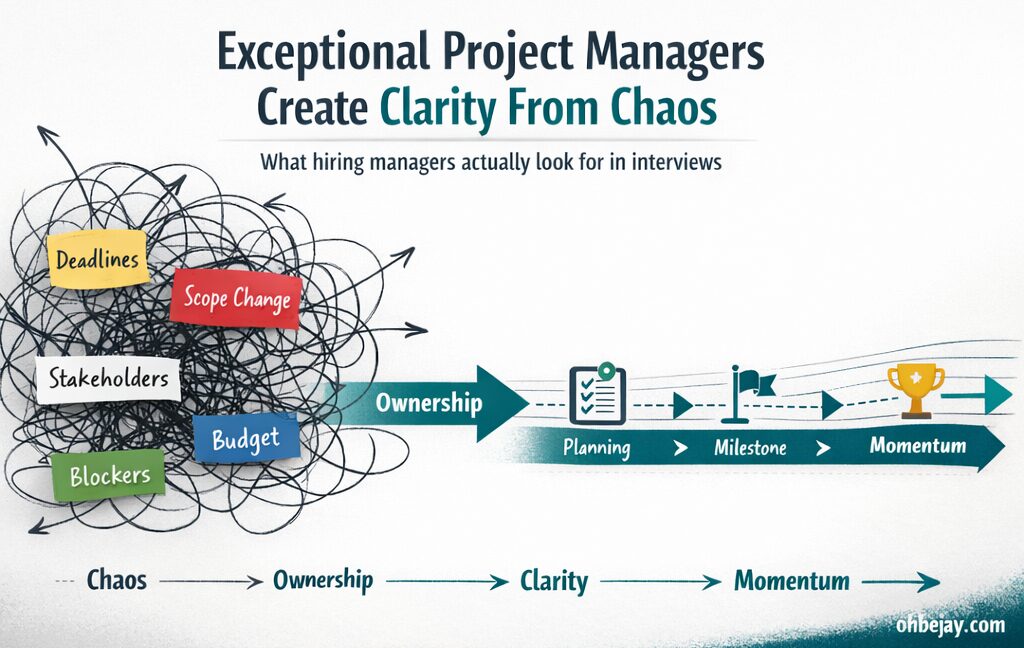
Strong project managers create clarity when situations are messy. They align stakeholders who disagree. They recover well when plans derail.
To understand what really separates average candidates from exceptional ones, we asked leaders who hire project managers what they look for in interviews.
Their answers reveal the real questions you’ll be asked when interviewing for a project manager positions.
What Hiring Managers Actually Look for in Project Managers
One theme appeared repeatedly: exceptional project managers take ownership.
Aditya Nagpal, Founder and CEO of Wisemonk, says the difference rarely comes down to technical knowledge.
“The difference between average and exceptional project managers is rarely technical knowledge. It is ownership.
The best project managers think like operators. They do not just track tasks. They understand why the work matters, who it impacts, and what could go wrong.”
In complex environments, clarity becomes one of the most valuable leadership skills.
“An exceptional project manager creates clarity where none exists. They break complexity into milestones, assign accountability, and keep momentum without escalating panic.”
Sergio Franco, Vice President of MetalRecruiters, sees something similar when making project management hires.
“What separates an average project manager from an exceptional one isn’t their ability to manage a timeline, it’s how they manage uncertainty. Most candidates can speak confidently about budgets, schedules, and tools. What hiring managers really want to understand is how someone behaves when the project gets messy.”
He says strong project managers consistently demonstrate three qualities:
- Ownership of outcomes
- Clarity in communication
- Ability to juggle competing priorities
The real skills come out when things don’t go according to plan.
Project Manager Interview Questions That Reveal Strong Candidates
The following questions appear frequently in project manager interviews because they reveal how candidates handle complexity, conflict, and uncertainty.
Tell me about a project that went off track. What did you do next?
Hiring managers often use this question to assess accountability.
Nagpal explains that the answer reveals emotional maturity and leadership presence.
“My favorite question to ask is simple: ‘Tell me about a project that went off track. What did you do next?’ The answer reveals emotional maturity, problem solving, and accountability. Strong candidates speak openly about tradeoffs, tough conversations, and lessons learned. Average ones deflect blame or focus only on external constraints.”
Interviewers want to hear how you recovered — not how perfectly the project ran.
Tell me about a project that was in trouble. What were the first steps you took?
Igor Golovko, Developer and Founder of TwinCore, likes to ask candidates how they handled a project crisis.
“I like asking: ‘Tell me about a time you shipped a project that was in trouble — what were the first three actions you took in the first 48 hours?’”
The response quickly reveals how candidates diagnose problems.
“Strong candidates can name concrete artifacts they produced and how they changed behavior across engineering and stakeholders.”
Great project managers don’t just add more meetings. They re-baseline plans, confirm ownership, and clarify the path forward.
How do you manage conflict within a project team?
Project managers often sit between competing priorities — executives, engineers, clients, and operations.
Jonathan Palley, CEO of QR Codes Unlimited, says communication and conflict resolution are core skills.
“The best project managers are, above all, great at communication and conflict resolution. Sure, planning and resource management are important, but we have tools to help with that aspect. Getting people to actually execute your plan, even when they have different ideas and conflicting opinions, is the real gift.”
In interviews, he often asks for specific examples of managing difficult team dynamics.
Strong answers focus on alignment rather than authority.
How do you handle stakeholder disagreements?
Many projects fail not because of technical issues but because of misalignment.
Franco explains that hiring managers want to see how candidates navigate competing demands.
“Exceptional project managers simplify complexity. They don’t overwhelm teams with jargon or dashboards; they align people. The best ones know how to translate technical detail into business impact, and vice versa.”
This question tests whether you can balance diplomacy, clarity, and decision-making.
How do you identify and manage project risks?
Exceptional project managers often anticipate problems long before they appear.
Shehar Yar, CEO of Software House, calls this conflict anticipation.
“Average project managers react to problems. Exceptional ones see friction points forming weeks before they become blockers and quietly resolve them.”
He often presents candidates with ambiguous scenarios to see how they think.
“Average candidates immediately jump to solutions. Exceptional candidates ask clarifying questions first. They want to understand the client relationship history, the team’s morale, and whether the requirement change affects the core architecture.”
This kind of thinking shows situational awareness — one of the most valuable project management skills.
How do you explain technical delays to non-technical stakeholders?
Project managers frequently serve as translators between technical teams and business leaders.
Yar says technical fluency matters — but not in the way many candidates assume.
“Our best PMs can read a pull request summary, understand dependency risks, and translate developer concerns into business language for clients.”
In interviews, he often asks candidates to explain a technical delay to a non-technical audience.
“The best responses use analogies and focus on impact rather than jargon.”
Strong project managers help people understand what’s happening and why it matters.
Common Mistakes Candidates Make in Project Manager Interviews
One of the most frequent mistakes candidates make is focusing too much on tools and frameworks.
Nagpal sees this often.
“A common mistake candidates make in interviews is over-indexing on tools. I often hear long explanations about dashboards, certifications, or frameworks. Tools are helpful, but they are not leadership.”
Franco agrees that methodology discussions can distract from the real evaluation.
“A common mistake candidates make in interviews is overemphasizing methodology — Agile vs Waterfall, which platform they use, how they structure reporting. Hiring managers are evaluating leadership presence and decision-making.”
Golovko notices a similar pattern.
“Many candidates say ‘I use Agile, I manage stakeholders, I remove blockers,’ but can’t walk through a real situation.”
Abhishek Pareek, Founder and Director of Coders.dev, sees another issue.
“A frequent mistake that I see when interviewing candidates is the propensity for the candidate to invest too much time explaining the tools or ceremonies they have used.”
In reality, tools support delivery — they don’t guarantee it. Hiring managers are more interested in how candidates handle setbacks, trade-offs, and stakeholder pressure.
How AI Is Changing Expectations for Project Managers
Another emerging theme is the growing role of AI in project management.
Nagpal explains that automation is shifting how project managers spend their time.
“Modern project managers should use AI to summarize updates, analyze risks, and streamline reporting. That frees them to focus on stakeholder alignment, critical thinking, and decision making.”
Chongwei Chen, President and CEO of DataNumen, has seen this shift firsthand.
“We now use AI tools like ChatGPT and Claude for software development and optimization. This means project managers should leverage AI for routine tasks while focusing their expertise on strategic decisions AI cannot make.”
Golovko notes that AI has raised the bar for communication quality.
“I now assume PMs can use AI to draft agendas, summarize threads, and produce first-pass risk logs. The differentiator is judgment: verifying accuracy, spotting what’s missing, and turning summaries into decisions.”
Although AI can accelerate project management tasks, it doesn’t replace leadership.
Traits That Separate Exceptional Project Managers From Average Ones
Across all the responses, one idea appears repeatedly: exceptional project managers know how to keep momentum going despite distractions.
Pareek describes the core of the project management role.
“Project management is ultimately a discipline of dealing with uncertainty, and the best leaders remain calm and focused when their plans are disrupted and quickly find the best way to restore value to their organization.”
Great project managers:
- Take ownership of outcomes
- Communicate clearly across teams
- Anticipate risks before they escalate
- Translate complexity into action
Those are the signals hiring managers listen for in interviews. Because in the end, project management isn’t about managing tasks. It’s about moving work forward when conditions are imperfect.
Want to feel ultra prepared for your next interview? This guide on common interview questions breaks down what you’re most likely to be asked.