

Table of Contents
“Tell me about yourself.”
It sounds simple. Open-ended. Almost casual. Here’s the truth: This question is not a biography request.
It’s your opportunity to frame how the interviewer sees you before the rest of the conversation unfolds.
What Interviewers Are Actually Asking
When an interviewer says, “Tell me about yourself,” they’re usually trying to understand:
- Who are you professionally?
- What context should I have for your resume?
- What do you consider most relevant?
- Why are you here?
They are not asking:
- Where you grew up
- Every job you’ve held
- A word-for-word reading of your resume
- Your entire career story in chronological detail
Most interviewers have only skimmed your resume before the meeting. This is often the first time they’re actually listening closely. That’s your chance to guide the lens.
An Answer Structure That Works
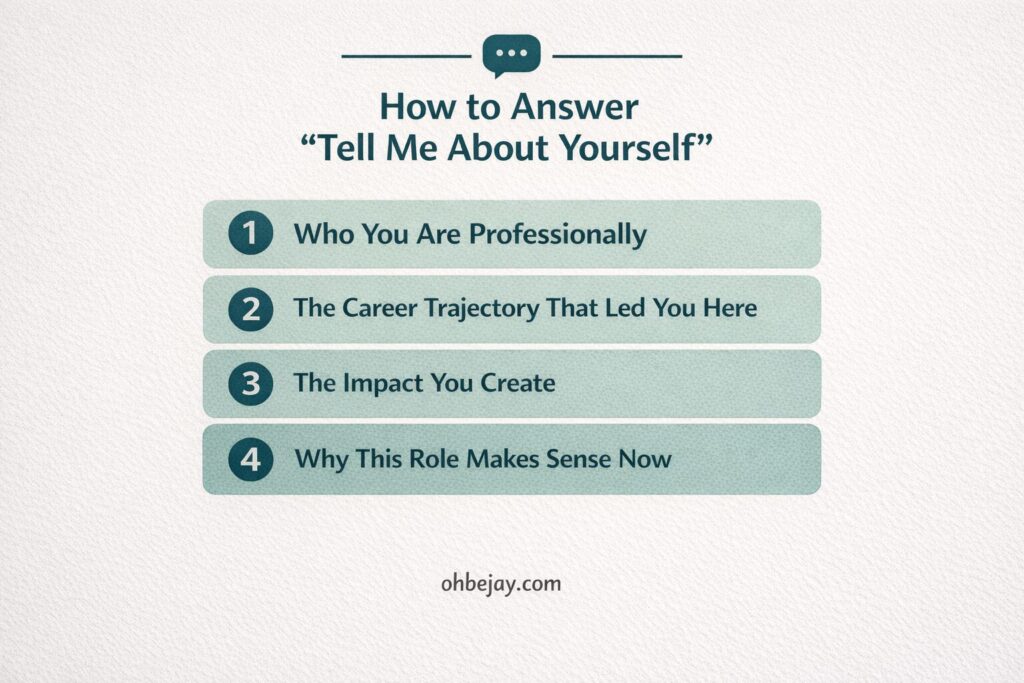
Here’s a clean way to structure about your answer:
- Who you are professionally
- The career trajectory that led you here
- The impact you create
- Why this role makes sense now
Let’s break that down.
1. Start With Your Professional Identity
Open with a concise summary of who you are in your field.
Not your job title alone. Think of it as your headline.
For example:
“I’m a data-driven marketing professional with three years of experience leading growth initiatives for SaaS companies.”That immediately tells them what you do.
2. Highlight Relevant Progression
Briefly walk through how you’ve grown to be where you are now.
Focus on:
- Increasing responsibility
- Expanded scope
- Deepened expertise
3. Emphasize Impact
This is where many candidates miss the opportunity to stand out.
Highlight any major accomplishments related to the role. For each, describe the positive impact it had to the team or business.
- What did you improve?
- What did you build?
- What changed because you were there?
4. Close With Mutual Alignment
End with why you’re here now and why this role is the perfect next step for you.
That might sound like:
“I’m now looking to step into a role where I can own larger cross-functional initiatives, which is why this opportunity stood out.”That final sentence connects your story to the conversation you’re having now. Without this closing, your answer can feel unfinished.
Sample Answers
Below are several sample answers to the interview question “Tell me about yourself.” We’ve tailored the sample answers based on various career stages.
Early-Career Professional
“I’m a recent communications graduate who’s spent the past two years working in digital marketing. I started in a coordinator role supporting campaign execution, and over time I took on more ownership of analytics and reporting. I’ve developed a strong interest in performance strategy, especially understanding what drives measurable growth. I’m now looking to join a team where I can continue building analytical depth while contributing to larger campaign planning.”Why this works:
Clear identity, progression, interest, and alignment.
Mid-Career Professional
“I’m a project manager with eight years of experience leading cross-functional initiatives in healthcare operations. I began managing smaller implementation projects and gradually moved into enterprise-level system rollouts. Most recently, I’ve focused on improving process efficiency and stakeholder communication across departments. I’m now looking for an opportunity where I can bring that operational clarity to a larger, more complex environment.”Why this works:
Shows growth, responsibility, and forward direction.
Career Pivot
“I'm a business analyst who's highly experienced in multiple industries. I started my career in customer support, where I developed strong communication and problem-solving skills. Over time, I realized I was most energized by analyzing trends in customer feedback and identifying process improvements. That led me to transition into a business analyst role, where I’ve spent the last three years working closely with product and engineering teams. This role stood out because it feels well with my strong cross-functional background.”Why this works:
It makes the pivot feel intentional and coherent.
Leadership Role
“I’m an operations leader with over five years of experience scaling teams in fast-growing environments. I began in an individual contributor role and moved into leadership as the organization expanded. In my most recent position, I managed a team of 10 and led initiatives that reduced both turnaround time and client response time. I’m now looking to bring that leadership experience to an organization focused on AI development, so this opportunity stood out.”Why this works:
It’s clear on the career trajectory.
5 Common Mistakes to Avoid
Even strong candidates make these mistakes.
- Starting too far back
You don’t need to begin with your first internship unless it’s directly relevant. - Talking too long
Aim to keep your answer around 1 to 2 minutes. Long enough to establish context. Short enough to maintain interest. - Reading from your resume
Responses that sound like a list of word-for-word bullet points aren’t natural. - Forgetting to connect to the role at hand
Without alignment at the end, your answer can feel generic. - Sounding overly rehearsed
While structure helps your answer, word-for-word memorization sounds too robotic.
Final Thoughts
Delivery matters more than you might think. This question sets the tone for the rest of the interview.
Before you answer, pause briefly. Not dramatically — just enough to collect your thoughts.
And remember: you’re not just describing your past. You’re positioning your future. A strong answer sets a positive tone for the rest of the interview. For more tips like these, check out our guide on common interview questions and answers.