

Table of Contents
You are not obligated to attend every interview you’re offered.
It’s okay to change your mind if you’ve accepted another offer or realized the role isn’t aligned. What matters is how you handle it.
Declining an interview isn’t unprofessional. In fact, it’s often more respectful than moving forward half-interested — or worse, disappearing entirely.
When It’s Reasonable to Decline
There are many valid reasons to turn down an interview invitation:
- You’ve already accepted another offer.
- The salary range doesn’t meet your expectations.
- The role responsibilities changed significantly.
- You researched the company, and it’s not a fit.
- The commute or schedule isn’t realistic.
- Your career direction has shifted.
In fact, declining early saves everyone time. The sooner you communicate, the better.
Declining Is Better Than Ghosting
There’s a lot of conversation about employer ghosting — when companies stop responding to candidates after interviews.
Candidate ghosting happens too. When a candidate simply doesn’t show up or stops responding, it creates the same breakdown in professionalism.
The job market works both ways. Employers and candidates are evaluating each other. Professionalism is about communicating promptly and considerately.
How to Politely Decline an Interview
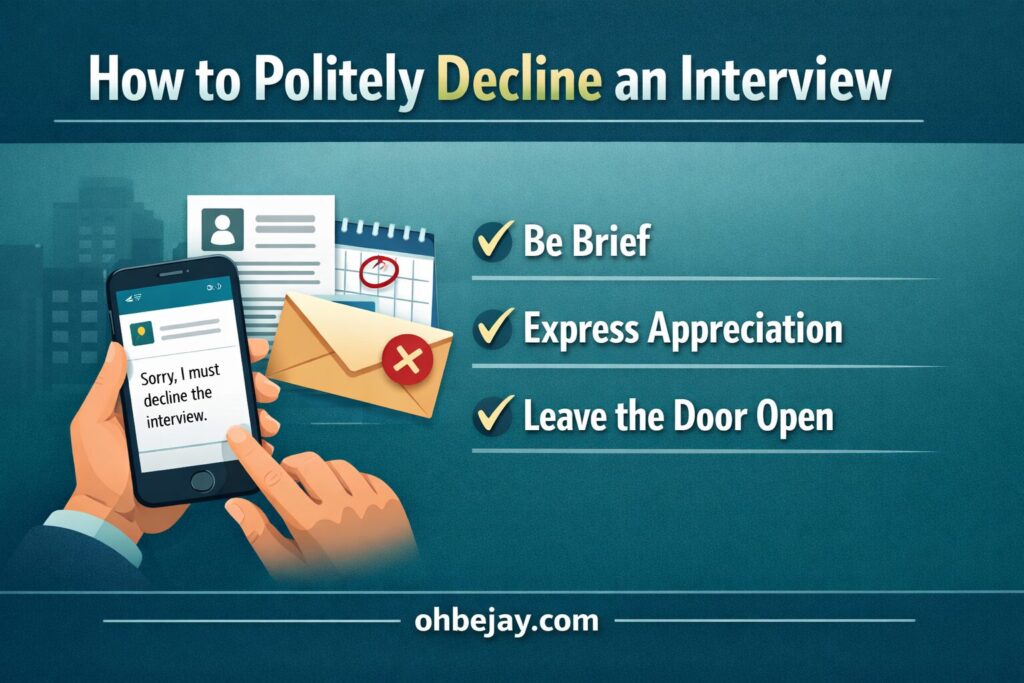
You don’t need a long explanation or a dramatic apology. A professional decline includes:
- A prompt response
- Appreciation for the opportunity
- A brief reason (optional)
- A polite close
Short and clear is better than overly detailed.
4 Sample Emails to Decline an Interview
Here are a sample emails depending on your situation.
General Decline
Subject: Interview Invitation – [Role] – [Your Name]
Hi [Name],
Thank you for the opportunity to interview for the [Role] position. However, I’m no longer interviewing at this time.
I wish you the best in filling the position, and please let me know if I can be of any help.
Best regards,
[Your Name]
If You’ve Accepted Another Offer
Hi [Name],
Thank you again for the invitation to interview for the [Role]. I wanted to let you know that I’ve recently accepted another opportunity, so I’ll need to decline this interview.
I appreciate your consideration and hope our paths may cross in the future.
Best,
[Your Name]
If the Salary or Role Isn’t Aligned
Hi [Name],
Thank you for reaching out regarding the [Role] position. After reviewing the details, I don’t believe the role is aligned with what I’m currently seeking.
I appreciate the opportunity and wish you success in your hiring process.
Kind regards,
[Your Name]
If You Want to Stay in Touch
Hi [Name],
Thank you for considering me for the [Role]. At this time, I’m going to step back from the interview process as I’ve chosen to pursue another direction.
I’ve enjoyed learning more about your team and would welcome staying in touch.
Best,
[Your Name]
Should You Give a Reason?
You’re not obligated to.
A brief reason can be helpful, but it’s best to keep it neutral and contained.
Avoid:
- Criticizing the company
- Negotiating unless you genuinely want to continue
- Over-explaining your decision
This email is about closing a loop.
Will This Burn a Bridge?
Not if you handle it professionally.
Recruiters and hiring managers understand that candidates are making decisions just like they are. In fact, responding clearly often leaves a stronger impression than staying silent.
Industries can be smaller than you think. The recruiter you decline today may reach out about a better-fit role in the future.
Clarity keeps doors open. Ghosting closes them.
Final Thoughts
It’s fine to decline an interview when you’re no longer interested in the opportunity. The goal isn’t to explore every opportunity. It’s to be available for the right ones.
Handled with respect and clarity, declining an interview can be seen as a very professional thing to do. It’s preferred to ghosting.
If you’d like additional support in handling those tricky interview moments, check out our free and paid resources.