

“Why did you leave your last job?”
It’s one of the most common interview questions — and one of the most loaded.
If you’ve searched for reasons for leaving a job, you’re probably trying to figure out two things:
- What counts as an acceptable reason?
- How do I say it without hurting my chances?
That makes sense. The truth is, most people leave jobs for completely reasonable reasons. Growth. Alignment. Change. Stability. Life.
But in an interview, it’s not just why you left that matters. It’s how your explanation lands.
This article does both:
- First, you’ll find 15 credible, professional reasons for leaving a job — clearly differentiated and interview-safe.
- Then, we’ll cover how to answer the question in a way that signals maturity, clarity, and forward momentum.
Let’s start with the list.
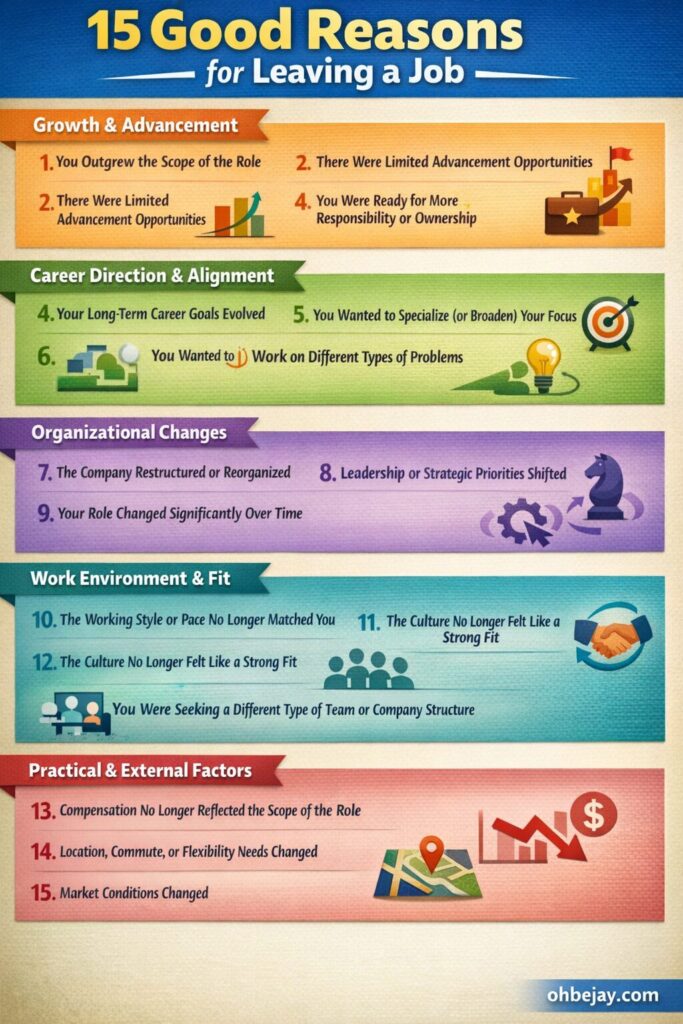
15 Good Reasons for Leaving a Job
Growth & Advancement
1. You Outgrew the Scope of the Role
Over time, you mastered the responsibilities and were no longer being challenged at the level of your skills. Wanting continued growth after reaching stability is a reasonable and professional reason to move on.
2. There Were Limited Advancement Opportunities
Some organizations have flat structures or limited openings at higher levels. If there wasn’t a clear path forward, it’s understandable to seek opportunities where progression is possible.
3. You Were Ready for More Responsibility or Ownership
You may have been operating at a higher level than your title reflected. Moving into a role with greater strategic input or leadership responsibility can be a natural next step.
Career Direction & Alignment
4. Your Long-Term Career Goals Evolved
Career paths aren’t always linear. As your interests and strengths became clearer, you may have realized your current role no longer aligned with where you wanted to head long term.
5. You Wanted to Specialize (or Broaden) Your Focus
Perhaps you wanted to go deeper in a specific skill area—or gain broader exposure across functions. Either shift reflects intentional development, not instability.
6. You Wanted to Work on Different Types of Problems
You might have been ready to move from maintenance work to growth initiatives, from internal operations to customer-facing strategy, or from execution to innovation. Seeking new types of challenges signals ambition and clarity.
Organizational Changes
7. The Company Restructured or Reorganized
Changes in reporting lines, team structure, or role scope can significantly alter a position. You can say the outcome of the company restructuring no longer aligned with your strengths or goals.
8. Leadership or Strategic Priorities Shifted
When a company changes direction, roles can shift with it. If the new priorities didn’t match your expertise or interests, exploring other opportunities makes sense.
9. Your Role Changed Significantly Over Time
Sometimes a job evolves beyond its original expectations. If the responsibilities drifted far away from where you do your best work, it’s reasonable to reevaluate things.
Work Environment & Fit
10. The Working Style or Pace No Longer Matched You
Whether the work environment became more rigid or significantly faster-paced, alignment with working style matters. Seeking a setting where you can perform at your best shows you have a strong self-awareness.
11. The Culture No Longer Felt Like a Strong Fit
Culture shapes how decisions are made and how people collaborate. If values or norms no longer aligned with yours, moving on can be a thoughtful decision.
12. You Were Seeking a Different Type of Team or Company Structure
Over time, you may have developed a preference for a specific type of work environment. For example, you might have wanted to move from a large corporation to a startup, from startup to enterprise, or from in-office to remote.
Practical & External Factors
13. Compensation No Longer Reflected the Scope of the Role
If your responsibilities expanded significantly without corresponding adjustments, it’s reasonable to look for opportunities that better match your impact.
14. Location, Commute, or Flexibility Needs Changed
Plenty of scenarios can fall under this category. For example: relocation, return-to-office policies, or switching to remote work.
15. Market Conditions Changed
Layoffs, funding concerns, or broader industry downturns can shift someone’s long-term industry outlook. Choosing stability or growth in a changing market is a responsible decision.
How to Answer “Why Did You Leave Your Last Job?” in an Interview
The list above gives you credible reasons. But in an interview, the reason itself isn’t the only thing being evaluated.
Interviewers ask this question to assess:
- Stability
- Professionalism
- Self-awareness
- Readiness for what’s next
They’re not looking for drama. What matters most is not the full story of what happened. It’s how your explanation lands now.
A strong answer quietly communicates three things:
- The situation is resolved.
- You understand why you left.
- You are focused on what’s ahead.
A weak answer tends to:
- Linger on frustration
- Blame specific people
- Sound emotionally unfinished
- Over-explain details
How to Structure Your Answer
A clear, reliable way to answer this question is:
Brief context → Neutral reason → Forward-looking focus
For example:
“Over time, I realized I had outgrown the scope of my role and there wasn’t a clear path for advancement. I’m now looking for a position where I can take on more ownership and continue growing.”
Or:
“The company went through a restructuring that significantly changed my responsibilities. I took some time to reassess what I wanted next, and I’m now focused on finding a role that aligns more closely with my long-term goals.”
Notice what these answers don’t do:
- They don’t criticize.
- They don’t overshare.
- They don’t linger on what went wrong.
They close the past and redirect attention to the future. That’s the tone you’re aiming for.
Common Mistakes to Avoid
Even though this is a common interview question, strong candidates can unintentionally weaken their answer here.
Being Too Detailed
You don’t need to narrate the full timeline of events. Keep it tight. If they want more detail, they’ll ask.
Sounding Apologetic
You’re allowed to leave a job. Career moves are normal. If you sound embarrassed about your decision, it can introduce doubt where none was necessary.
Blaming Your Manager or Team
Even if your experience was difficult, framing it negatively rarely helps you. Interviewers tend to interpret blame as risk.
Oversharing Personal Circumstances
If your reason involves health, family, or burnout, keep it matter-of-fact and resolved. The goal is reassurance, not vulnerability.
Frequently Asked Questions
What is the best reason for leaving a job?
There isn’t one “best” reason. The strongest reasons are neutral, forward-looking, and aligned with growth, stability, or fit. What matters most is how calmly and clearly you explain it.
Is it okay to say I left for more money?
Only if framed professionally. For example, you can say you were seeking compensation that better reflected your responsibilities or market value. Avoid sounding resentful about previously being underpaid. And avoid sounding like you’re only on money more than the not the content of the role.
Can I say I didn’t like my manager?
It’s better to reframe this. Instead of focusing on personality conflict, you might describe a mismatch in working style or priorities and redirect toward what you’re seeking now.
What if I was laid off?
Layoffs are common and generally not viewed negatively. Keep your explanation concise and pivot quickly to what you’ve been focused on since.
Should I always be completely honest?
You should be truthful — but selective. Interviews aren’t therapy sessions. Share what’s accurate and relevant, and keep it framed professionally.
Final Thoughts
Leaving a job is normal. Growth is normal. Change is normal.
The key is delivering your reason in a way that demonstrates maturity and forward momentum.
When your explanation feels clear and contained, interviewers are far more likely to move on to what matters most — what you can do next.
For tailored guidance on how to answer interview questions, check out our Hard Questions Interview Training. It’s best suited for professionals that have 3+ years of work experience.